Tiger vs Zojirushi Rice Cooker: Which Brand Should You Pick? (November 2026)
Choose Zojirushi for a wider range of rice settings, or Tiger for a Tacook tray that cooks rice and a main dish together. Your household size and cooking routine should guide the choice.
On this page (8 sections)
- Tiger vs Zojirushi rice cookers: what is the main difference?
- Which brand has the right capacity for your household?
- Which brand gives you more cooking control?
- What can you cook at the same time?
- How do their keep-warm and storage features compare?
- Which model is the better fit for your kitchen?
- Which products stand out in this comparison?
- How should you decide between Tiger and Zojirushi?
Choose a Zojirushi for more rice-specific menu settings, or a Tiger for a Tacook tray that cooks rice and a main dish together. In a Tiger vs Zojirushi rice cooker comparison, batch size and how you plan meals matter as much as cooking controls.
The Zojirushi Neuro Fuzzy offers settings for several rice types, including porridge, brown, sweet and rinse-free rice. Tiger’s JBV-A10U and JBV-A18U each have 4 automated settings and a tray designed for cooking another dish while the rice cooks.
If you want a closer look at automatic rice cooker features, start with the controls and routines you’ll use most often.
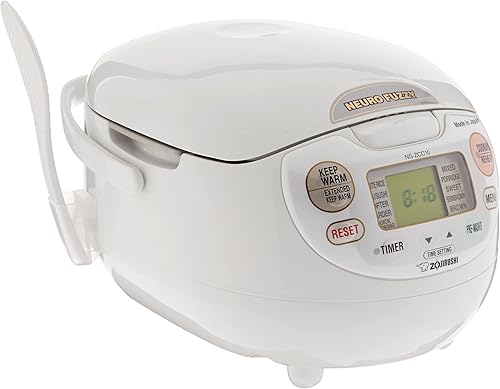 Best for rice setting variety
Zojirushi Ns ZCC10 Neuro Fuzzy Rice Cooker

Tiger vs Zojirushi rice cookers: what is the main difference?
Zojirushi offers more rice menu options in the Neuro Fuzzy model; Tiger adds a Tacook tray to its JBV-A10U and JBV-A18U. That makes Zojirushi a natural fit for varied rice routines and Tiger a useful fit for two-dish meals.
The Neuro Fuzzy has settings for white rice, mixed rice, porridge, sweet rice, semi-brown rice, brown rice, rinse-free rice and quick cooking. Its white setting also offers regular, softer or harder options.
Tiger keeps the menu simpler. Both models cover plain rice, brown rice, slow cook and steam, with the Tacook tray designed to cook vegetables or proteins while rice cooks.
For Tiger’s brown rice cycle, see Tiger brown rice instructions.
Which brand has the right capacity for your household?
Choose capacity based on your usual batch, not the biggest number alone. The 10-cup Tiger JBV-A18U suits larger batches, while the 3-cup Zojirushi suits smaller meals and limited counter space.
The JBV-A18U holds up to 10 cups of dried rice, and Tiger says that yields about 20 cups cooked. The JBV-A10U and Neuro Fuzzy each hold 5.5 cups uncooked, while the compact Zojirushi has a 3-cup capacity and can cook as little as half a cup of rice or oats.
Tiger rice cooker vs Zojirushi for small batches
The compact Zojirushi is the clearest choice when you often cook a small serving. Its steel-cut oatmeal setting and long-grain white setting also support meals beyond short- or medium-grain rice.
The Tiger JBV-A10U is a better fit if a 5.5-cup capacity matches your routine and cooking another dish in the Tacook tray appeals to you. See more options in our guide to the best Tiger rice cooker.
When does a 10-cup Tiger make sense?
The JBV-A18U is worth considering if you often prepare rice for a larger household or make bigger batches. Its 10-cup uncooked capacity is nearly twice that of the JBV-A10U and Neuro Fuzzy.
It measures about 15.1 in deep, 11.9 in wide and 10 in high. Check your counter before choosing it, since the larger capacity also means a larger footprint.
Which brand gives you more cooking control?
Zojirushi’s Neuro Fuzzy gives you more rice-specific menu choices, while Tiger combines a shorter menu with its synchronized tray. Think about whether you want different rice textures and types or a second dish cooked alongside rice.
The Neuro Fuzzy includes regular, softer and harder white-rice options, along with choices for porridge, mixed, sweet, semi-brown, brown and rinse-free rice. It also has quick cooking, a timer, an LCD clock, automatic keep-warm, extended keep-warm and reheat cycles.
The compact Zojirushi takes a different approach, with dedicated settings for steel-cut oatmeal, long-grain white and brown or GABA brown rice. Its fold-down handle and retractable cord make it easier to carry and store.
Tiger’s 4 settings cover plain rice, brown rice, slow cook and steam. The standout is the Tacook tray: Tiger says it can cook vegetables or proteins while rice cooks, without affecting the rice’s flavor.
What can you cook at the same time?
Tiger is the clear choice if you want a tray for rice and a main dish in one cooking cycle. Both Tiger models include a Tacook tray designed for vegetables or proteins.
That feature can suit a simple meal plan built around rice and one tray-cooked item. The JBV-A10U provides this function in a 5.5-cup model, while the JBV-A18U offers it at 10 cups.
The Neuro Fuzzy and compact Zojirushi focus on rice settings rather than a synchronized second dish. If you mainly want rice, oatmeal or porridge, those options may align better with your cooking habits.
For another view of Japanese brands, compare the best rice cooker Japanese brands and their different approaches to capacity and controls.
How do their keep-warm and storage features compare?
Both brands offer useful convenience features, but they differ by model. The Neuro Fuzzy has automatic and extended keep-warm plus reheat cycles; the Tiger models keep rice warm for up to 12 hours.
The Neuro Fuzzy also has a delay timer with 2 settings and a retractable cord. The compact Zojirushi has a retractable cord and fold-down handle, which can help if you need to move or store it between meals.
The Tiger JBV-A10U and JBV-A18U include measurement markings in their inner pots and come with a rice measuring cup. Follow the included cup when measuring rice, since the cup size may differ from a standard kitchen cup.
Which model is the better fit for your kitchen?
Choose by the feature you’ll use most: menu range, synchronized cooking, batch size or compact storage. No one model covers every household routine.
The Neuro Fuzzy fits cooks who make several kinds of rice and want more menu settings. The compact Zojirushi fits smaller portions and cooks who also make oatmeal.
The Tiger JBV-A10U suits households that want a mid-size cooker with a Tacook tray. Choose the JBV-A18U if you want the same two-dish approach with more capacity and have the counter room for it.
If you’re comparing brands with an elephant logo, our guide explains the rice cooker elephant brand. For a focused look at Zojirushi’s choices, see the best Zojirushi rice cooker.
Which products stand out in this comparison?
The Zojirushi Neuro Fuzzy is the best fit for rice-setting variety, and the Tiger JBV-A18U is the best fit for larger two-dish meals. The JBV-A10U brings Tiger’s tray to a smaller capacity, while the compact Zojirushi serves small batches.
For another appliance-brand comparison, read What Is the Best Air Fryer Brand to Buy? or see Does Air Fryer Brand Affect Food Quality?. If you’re specifically weighing Tiger’s microcomputer models, our guide to the best Tiger rice cooker Micom options can help.
How should you decide between Tiger and Zojirushi?
Pick Zojirushi for a wider choice of rice settings, or Tiger when its Tacook tray suits how you cook dinner. Then match the capacity to the amount you normally make.
Choose the Neuro Fuzzy for different rice types and keep-warm options, the compact Zojirushi for small batches, the JBV-A10U for a mid-size two-dish setup, or the JBV-A18U for larger batches. Your usual menu and counter space will point to the best fit.
Frequently asked questions
Is Tiger or Zojirushi better for rice?
Zojirushi suits cooks who want a wider choice of rice settings, while Tiger suits people who value its Tacook tray for cooking rice and a main dish together. The Zojirushi Neuro Fuzzy has settings for several rice types; both Tiger models have 4 automated settings.
Which brand has the larger rice cooker?
The Tiger JBV-A18U has the largest capacity in this comparison at 10 cups of uncooked rice. The Zojirushi Neuro Fuzzy and Tiger JBV-A10U each hold 5.5 cups, while the compact Zojirushi holds 3 cups.
Can a Tiger rice cooker cook rice and another dish together?
Both Tiger models here include a Tacook tray designed to cook rice and a main dish at the same time. Tiger says the tray can cook vegetables or proteins without affecting the rice's flavor, giving you a way to prepare two parts of a meal in one cooker.
Which rice cooker is better for a small household?
The 3-cup Zojirushi is the smallest choice and can cook as little as half a cup of rice or oats. The 5.5-cup Tiger JBV-A10U is another option if you want more capacity and the Tacook tray for preparing a second dish.
Do Tiger and Zojirushi rice cookers have the same settings?
No. The Tiger JBV-A10U and JBV-A18U have 4 automated settings: plain rice, brown rice, slow cook and steam.
The Zojirushi Neuro Fuzzy includes more rice menu choices, while the compact Zojirushi adds dedicated settings for steel-cut oatmeal and long-grain white rice.